Regenerative science, thoughtfully applied.
The science behind Olorin™ explained honestly and in depth.
THE BODY HAS ALWAYS KNOWN HOW TO SUPPORT ITSELF.
Olorin™'s approach is grounded in how biological systems naturally communicate, repair, and renew, and in applying the most advanced available science to support those processes in the ocular environment.
The Olorin™
Luxury Relax & Regenerate Mask.
The Olorin™ Luxury Relax & Regenerate Mask pairs gentle, controlled warmth with a soothing air-compression massage, applying comforting heat around the eyes to encourage relaxation and support healthy circulation in the delicate tissue surrounding them.
Its warming layer helps soften and comfort the eyelid area, while sequential air-compression zones deliver a gentle, kneading massage and soft vibration around the temples and brow — a calming ritual designed to ease everyday eye strain and support ocular surface comfort.
A full overview of the mask and how to use it as part of your protocol is included in the Olorin™ Vision Science Library, available to all protocol members.
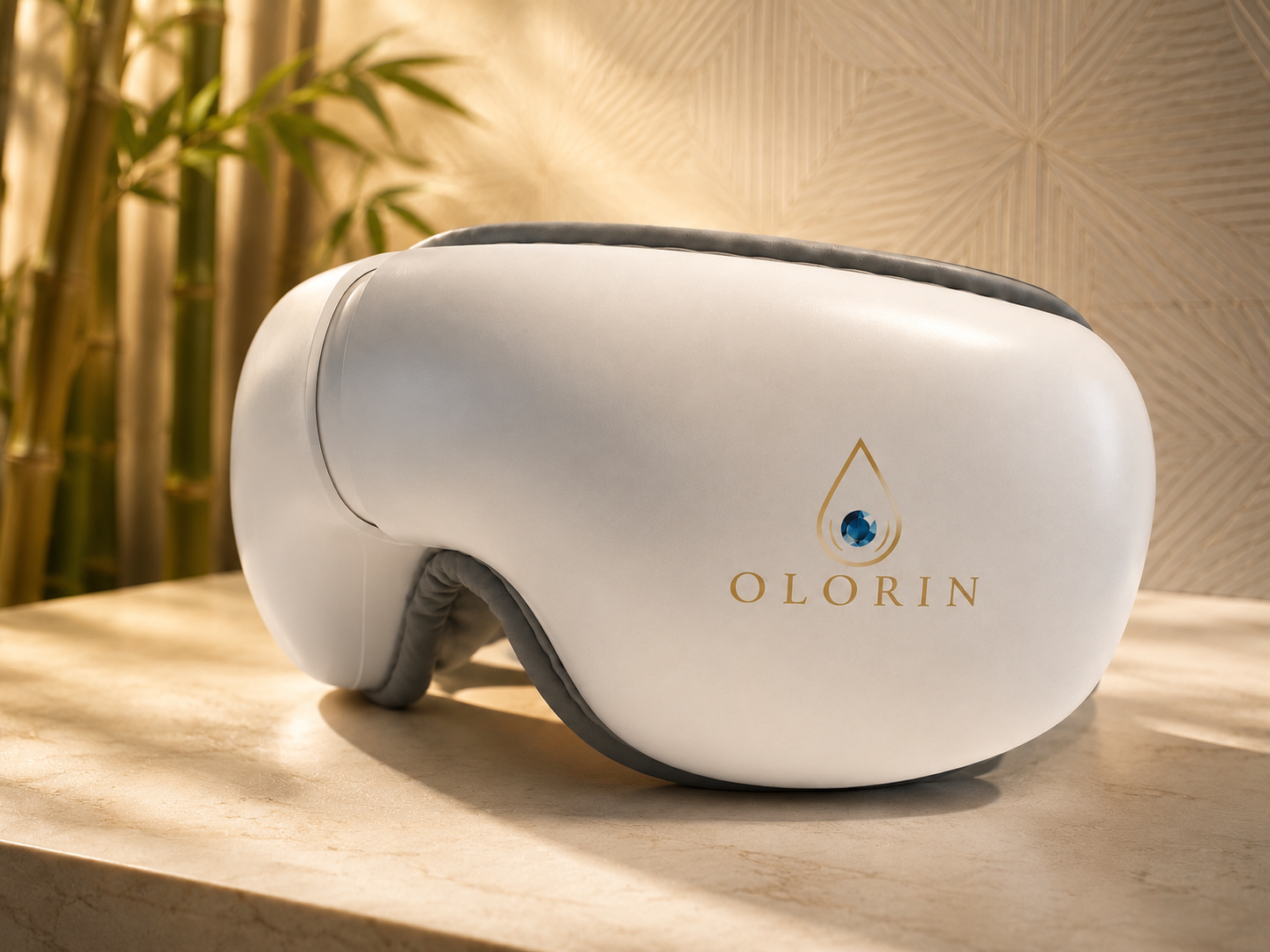
The Olorin™ Luxury Relax & Regenerate Mask and the Olorin™ formulation work through distinct mechanisms, together creating a multi-modal approach to ocular cellular wellness that is greater than either component alone.
Where advanced science supports your wellness.
These represent the ocular wellness areas most relevant to people exploring the Olorin™ protocol, described in the context of long-term cellular wellness, not medical treatment.
The Science of Ocular Wellness
An educational library for the curious.
The eye is one of the most metabolically active environments in the human body... and one of the most protected. Understanding how it maintains itself, defends itself, and responds to the demands of age and modern life is a field of research moving faster today than at any point in history.
This library is our way of inviting you into that conversation. The studies below represent a growing body of peer-reviewed research in regenerative ocular science — spanning cellular communication, the biology of the retinal pigment epithelium, and emerging delivery science being explored in laboratories and clinical settings around the world.
We share this research for educational purposes, because we believe an informed community is an empowered one. These studies were conducted by independent researchers and institutions. They are not studies of Olorin products, and they are not presented as evidence of any product's effects.
Science. Nature. Vision.
In a triple-blinded randomized clinical trial — the most rigorous study design in medicine — exosome eye drops derived from stem cells meaningfully relieved dry eye in human participants. One of the first studies of its kind to test exosome drops this rigorously in people.
In this human trial published in Science Advances, exosome eye drops brought relief to patients with severe, treatment-resistant dry eye — eyes that had not responded to conventional therapies, including steroids, improved within weeks of treatment.
This study documents the safety and effectiveness groundwork required to bring an adult retinal pigment epithelial cell therapy into FDA-regulated human trials — a signal of how rapidly regenerative vision science is maturing from laboratory to clinic.
A 2026 review cataloguing the exosome-based studies and human clinical trials now underway around the world for dry eye — evidence that this field is actively moving from the laboratory into clinical practice.
A foundational review of the retinal pigment epithelium — the hardworking layer of cells that nourishes, protects, and renews the light-sensing cells of the eye — and why its health is central to lifelong vision.
Scientists discovered that retinal pigment epithelial cells naturally package a protective protein into exosomes and send it to neighboring cells — one of the first demonstrations that the eye uses exosomes as its own built-in defense and repair system.
Researchers delivered exosomes produced by retinal pigment epithelial cells into degenerating retinas and found they protected the light-sensing cells, eased structural damage, and reduced the loss of visual function.
Scientists traced the protective power of stem cell therapy in retinal degeneration to a specific molecule carried inside exosomes — and showed that the exosomes themselves preserved light-sensing cells and protected long-term retinal function.
Weekly treatment with tiny vesicles released by stem cells helped light-sensing cells in the retina survive longer and preserved their structure — and the treated eyes showed measurably better visual function, not just healthier-looking tissue.
Stem cell exosomes protected the retinal pigment epithelium and the light-sensing cell layers from oxidative damage in a model of dry macular degeneration — working through one of the body's own natural antioxidant defense pathways.
In this study, exosomes shielded human retinal pigment epithelial cells from the kind of damage caused by blue light — the same light our screens emit all day — reducing cellular stress, inflammation, and cell death in a dose-dependent way.
A recent review of how stem cells and their exosomes protect retinal cells — calming inflammation, reducing oxidative stress, and interrupting the cellular processes that lead to degeneration.
A comprehensive review of stem cell exosome research across the major conditions of the eye — including studies where treated eyes showed improved survival of light-sensing cells, preserved retinal structure, and better visual function.
One of the newest reviews in the field shows exosomes doing something remarkable: not just protecting retinal nerve cells, but supporting actual regeneration within the visual system.
This review maps where exosome science stands on the path toward clinical use in eye care — cataloguing the studies, the mechanisms by which exosomes protect retinal cells, and the human trials currently underway around the world.
A wide-angle review of how exosomes function across the retina, cornea, and lens — in health, in disease, and as emerging tools for protecting the cells that make vision possible.
An open-access review of exosomes as the eye's own communication network — how they help maintain ocular health, and why topical application has become the most commonly used delivery route in ocular exosome research.
This review explains how exosomes are able to cross the eye's natural protective barriers — the very quality that makes them one of the most promising delivery vehicles in all of ocular science.
Olorin products are not intended to diagnose, treat, cure, or prevent any disease. The research below is provided for general educational purposes only and reflects the work of independent third parties. Always consult your physician regarding any medical condition.
Testimonials from our community.
In Their Own Words"I've been in the wellness space for fifteen years and I have a pretty high bar for products that call themselves regenerative. I did my homework before ordering. What sold me was the science behind it and the way the protocol is structured. It's not just drops. The mask that comes with it, I use it every morning after I apply the drops. Just sit back, breathe, let my eyes rest for a few minutes before the day starts. My vision felt cleaner about two weeks in. Less fatigue by the end of long teaching days. I've recommended it to people in my community who were asking about natural eye support. It's the real thing."
"I was skeptical of anything marketed as regenerative because that word gets thrown around a lot. But I looked into the science before ordering and it made enough sense to try. The discomfort I'd just normalized? It's less. I'm more comfortable because my eyes aren't bothering me constantly. I'll take that."
"I developed floaters after retirement. As a former nurse, I know enough anatomy to understand they don't always go away on their own. I read through the science on Olorin before purchasing, which I appreciated being able to access. I wanted to understand what was actually happening, not just trust marketing copy. Things look clearer to me than they did six weeks ago. The mask that comes with it is a nice touch too — I use it right after the drops, just ten minutes or so with my feet up. I'm going to keep using it. I've already mentioned it to two former colleagues who have the same issue."